Thursday, April 29, 2021

गुलिस्तां

Ek gulistaan aaj ujada pada hai
Phir basega
Par jiski duniya ujad gayee ho
Woh gul kee talash nahee karega
Woh khilkhilahat, Woh muskaraahat
Agar lautee bhi to Uske peechhe
Ek dard chhupa rahega
Khuda ke apane khel hain
Woh kab, kyun, kahan, kya karta hai
Koi nahi janata
Hey ishwar, Hey allah, hey maalik
Ab to humen baksh de
Hum insaanon se huigaltiyon ko
Maaf Kar de.

Pradeep/April 30, 2021


गुलिस्तां

एक गुलिस्तां आज उजड़ा पड़ा है
फिर बसेगा
पर जिसकी दुनिया उजड़ गई हो
वो गुल की तलाश नहीं करेगा
वो खिलखिलाहट, वो मुस्कराहट
अगर लौटी भी
तो उसके पीछे एक दर्द
छुपा रहेगा
खुदा के अपने खेल हैं
वो कब, क्यों, कहां, क्या करता है
कोई नहीं जानता
हे ईश्वर, हे अल्लाह, हे मालिक, अब तो रहम कर
अब तो हमें बख्श दे
हम इंसानों से हुई गलतियों को
माफ़ कर दे।

प्रदीप/अप्रैल ३०, २०२१.

सन्नाटा/Stillness

सन्नाटा

वो दम घोटता धुंआ
शायद उस मां की लाश से उठ रहा होगा
जिसका बेटा उसे जलाने नहीं पंहुच सका होगा
उस भाई का होगा जिसके अंतिम दर्शन को 
भाई तड़पता रहा होगा
उस बहन का होगा जिसका भाई
अब राखी पर अपनी सूनी कलाई देखेगा
उस बेटे का होगा जिसका बाप
कलेजे पर पत्थर रख सांस ले रहा होगा
उस दोस्त का होगा जिसने 
सारी जिंदगी उसे हंसाया होगा
और उस पत्नी का होगा जिसने
साथ जीने मरने का वादा किया होगा
हां कुछ ऐसे वादे भी पूरे हुए हैं
साथ जिए हैं और साथ मरे हैं
गड्ढों की खुदाई से तेज़ आती लाशें
जो कल अजनबी वो आज
एक ही गढ्ढे में
साथ सोते साथी
कुंभ में डुबकी, और मोक्ष पाने की चाहत भी
पूरी हुई होगी
अपने नेता की चुनावी सभा और उसे 
सत्ताधीन कराने की तमन्नाएं
अधूरी रही होगी
वो कर्णभेदी एंबुलेंस की लगातार आती आवाज़ें
वो रोती बिलखती अपीलें
कहीं ऑक्सीजन की कमी से 
दम घुटने की तो कहीं
धुएं की घुटन सांसों को भेद रही है
अनिश्चित सी लगती जीने की तमन्नाएं
एक अजीब सा सन्नाटा है
एक अजीब सा सन्नाटा है।

प्रदीप/अप्रैल २९, २०२१


Stillness
That suffocating smoke,
Must be rising from that mother's body
whose son couldn't reach there for her last rites
Must be of the brother whose brother
must have been desperate to see him one last time Must be of the sister whose brother would see his empty wrist next Rakhee
Must be of the son whose father is seeing this with a heavy stone on his heart
Must be of a friend who made him laugh 
for a life time
Must be of the wife who had vowed to live and die together
Yes, such promises have come true 
They lived and died together
Bodies reaching faster than they could dig graves
Those never met now friends lying together in one grave
Wishing for moksha found that in Kumbh
Unfilled are the wishes of voters attending election rallies, alas! Couldn't see their benefactor rule
The ear piercing noise of ambulances
The heart rendering appeals for oxygen scarcity of which is taking people to another world
Rising smoke from crematoriums 
making you breath harder and harder
Unfinishined desires may remain so
Stillness here is so noisy
Stillness here is so noisy.

Pradeep/April 29, 2021.


हालात

हालात

साहित्य आज शर्मिंदा खड़ा है
सच्चाई बयां नहीं कर सकता
और जो सुनना चाहते हैं 
उसमे सच्चाई नहीं
सब कहते हैं कि सकारात्मक सोचो
सकारात्मक कहो
क्या सच्चाई से मुंह मोड़ना ही
सकारात्मकता है
दुखों के पहाड़ों पर खड़े
लाशों के ढेरों को देखते
आप मुंह फेर सकते हैं?
शायद हां अगर आपबीती ना हो तो
युद्ध में योद्धा को पहले आगे बढ़ना पड़ता है
तब विजय होती है
मरता तो प्यादा ही है
सेनापति नहीं
दुख और सुख एक ही सिक्के के पहलू हैं
आज एक उछल कर आया है, अगली बार
दूसरा आएगा
मुंह फेरने से सच्चाई नहीं बदलती
जैसे सुख को गले लगाते हो वैसे ही
दुख को भी अपनाओ, नहीं भी अपनाओगे तो
उसने कहीं जाना नहीं है 
सिर्फ आप अपने सिक्के का उछालना टाल पाओगे।
नहीं साहित्य शर्मिंदा नहीं है अपने बयान से
जिन्हे होना है वे शायद शाही ठिकानों में छीपे बैठे हैं
सच्चाई उन्हें भी खींच लाएगी
क्योंकि सच्चाई तो सच्चाई हैं।
छिपाए नही छुपती
छिपाए नहीं छुपती।

प्रदीप/अप्रैल ३०, २०२१

Monday, March 15, 2021

बैल जोड़ी और दीया - coalition politics. Betma diaries.


"जिस दीये में तेल नहीं, सरकार बदलना खेल नहीं".. I heard when I was busy preparing for exams for my 6th standard in February 1967. A few minutes later I heard " कांग्रेस के भूखे बैल, खा गए शक्कर पी गए तेल".  A 9+ year old boy in me was thoroughly confused, but the excitement soon built up and so was the curiosity. Some enquiries here and there suggested that the two rival political parties Congress and Jansangh were fighting something called election to choose the government in Bhopal and in Delhi. Having read something or other about Jawaharlal Nehru and Gandhi of Congress and about the religious parties I did not take long to pick up the round and colourful metallic badge that I could sport on my chest with a welded pin at the back. I became a proud supporter of INC displaying the symbol, a pair of oxen. Since that day until election results there were several rallies of many candidates not just these two main parties, going through the labyrinths of village. Invariably, in the front there will be about a dozen or so children including me, followed by some elders and once in a while candidates also joined but on those days rallies will be much larger. People would welcome leaders and candidates by garlanding them whenever they passed through their houses, some would also put a tilak on their foreheads all the while loudest cheers would be by the children walking in front, me included.

1967 was an interesting year politically and various leaders who came and addressed public rallies in the only possible place in Betma's Poora Bazaar aka Bada Bazaar. For every party the stage used to get prepared at far end from main road just opposite Bank Of India and in most rallies the crowd would occupy  place right up to the main road and sometimes even beyond that to gaadi adda that was at a slope from where people could see nothing. The PA system using the horn type long speakers from Ahuja Radios (or sometimes some other local suppliers) would ensure that people standing even half a kilometre away could also listen to the leaders.  

The leader whose persona and speeches I liked most, however, was Homi Daji a handsome Parsee gentleman in his early forties who delivered fiery speeches. He was a leader of peasants and had touched chords with people. He was from a party called Communist Party of India (CPI) and the party symbol was a Red Sickle and wheat ear (हंसिया बाली). He was also the sitting Member of Parliament from Indore constituency that we were a part of. The candidates challenging him were Prakash Chandra Sethi of Congress and Satyabhan Singhal of Jansangh. Elections were being held simultaneously for Loksabha (parliament) and Vidhansabha ( state assembly). I don't remember names of assembly candidates but the fight was triangular there too.. from Congress there was Bhagwat Sabu who was from a village called Harsola near Mhow and I wondered why was he running from our (Depalpur) constituency that is not his home. In those days Socialist Party had just split in two SSP and PSP (praja socialist party) and PSP was stronger and was a bigger challenge than Jansangh for assembly elections. PSP had banyan tree as their symbol and someone with surname Patel was their candidate. PSP supporters were called झाड़ छाप (tree kind/type).

In one of the public rallies Rajmata Vijayaraje Scindia also came with her daughter Usha Raje who must have been in prime of her youth in early twenties. Both of them were full of exuberance and spreading glow as royals do. That was also the first time I saw a big diamond ring that adorned Rajmata's fingers. Rajmata ( Royal mother) who was the last queen of Gwalior the largest kingdom of Madhya Pradesh. She was a Congress leader but had some personality clash with Indira Gandhi when later became Prime Minister. She was an MP from Guna (1962-67) and had just left Congress party and joined Jansangh. She had also had some tiff with the then Chief Minister DP Mishra, a very honest, upright and strict administrator due to both these reasons she was hell bent upon defeating Congress in both parliamentary and assembly elections. She was the master planner of bringing the first non Congress government in MP and one of the first few in the country. 

After a lot of heat when election results came Prakash Chandra Sethi and Bhagwat Sabu were victorious. I felt bad for the charming Home Daji of CPI who certainly had more attraction not just in looks but in his speeches and apparently connections with masses that people say was apparent of the public work he did as a parliamentarian. Of the 296 assembly seats Congress was winner on 167 and Jansangh at only 78. DP Mishra had the mandate to come back as CM for another term. But that was the beginning of modern phase of Chanakya type politics in India. What we see today is quite common as horse-trading was not present in those days. Rajmata planned and played her cards well and split Congress and when the assembly was in its first session some 26 MLAs led by DP's able deputy Govind Narayan Singh moved from treasury benches and sat with the opposition declaring a war on Congress and claimed of forming a first-ever non-congress government under Govind Narayan Singh. Before the floor test most of 26 MLAs got abducted and taken to Gwalior and further to Delhi and suddenly resurfaced in assembly on the day of the floor test a few days later. It was quite obvious that they all got  "compensated" handsomely. The new CM was not new to politics he had been a minister for a long time and his father was the first CM of Vindhya Pradesh before formation of Madhya Pradesh. So with 26 MLAs crossing the fence Congress was reduced to 141, 8 short of majority. The new formation of all other parties and independents  with some 20 different ideologies formed the new government as संविद (संयुक्त विधायक दल) सरकार ..essentially a thorough khichari. But Govind Narayan Singh learnt early days that it will be difficult for him to carry on. Money paid was also to be recovered and the first casualty to generate money fell on appointments and transfers. If one were to believe available history Rajmata was running the government back seat driving using her aide Sardar Angre to give commands to CM. Short of two years Govind Narayan Singh was fed-up and refused to "obey" Angre on some appointments and as a fall out told Rajmata that he made a mistake leaving Congress that is in his blood and he is returning back in the fold. But all those 26 MLAs could not be cajoled immediately and Raja Naresh Chandra Singh another hardcore congressman and a tribal king was roped in to lead Samvid government. Alas! This simple and pure at heart tribal king who was loved by his subjects when they ruled the princely state Sarangarh, was not a politician who played dirty and so he lasted just 12 days, 4 days shorter than Aral Behari Vajpayee's  16 of his first term as PM later in 1996.

Many years later, I was happy to have Ashok Singh, former CM Govind Narayan Singh's younger son as my classmate in Engineering college, although he had joined a year before me but since he took a one year drop we were leveled, he still is a friend and thankfully stayed away from politics unlike his father, grandfather and brothers.. 

But Indira Gandhi who was concentrating power in Delhi didn't allow either DP Mishra or Govind Narayan Singh to return as CM instead chose Shyama Charan Shukla son of first CM of the newly formed Madhya Pradesh in 1956, Ravishankar Shukla. Shayama Charan's ministry had lots of new faces and Bhagwat Sabu our MLA was also one of them. Betma turned jubilant and sweets were distributed as it was for the first time that its representative had become a minister. It's regretful that both it's representatives in Bhopal and in Delhi Bhagwat Sabu and Prakash Chandra Sethi, especially Sethi ji who held several important ministries of the country like home and railways in Delhi did very little for the progress of their constituency in their entire career. One example is that of Indore's connectivity with other major business hubs, that still hurts. Indore was always a major business centre of the MP and could have rivalled Bombay and Ahmedabad but for its failure to have a proper railway connectivity that didn't come to it even when PC Sethi was a railway minister. Betma was also promised a rail connectivity on Indore-Dahod route in a survey conducted as early as 1952 but even today after 69 years that project is yet to see the light of the day. That connectivity would have given Indore prominence by bringing Delhi-Bombay route closer and Betma also would have been a different and better place.

That apart, when Sabuji became a minister what he worked hard for was to bring Shyama Charan Shukla (Popularly Shyama Bhaiya) to Betma. As an approaching 12 year old now, I was a lot excited with the prospect of seeing a CM for the first time in my life and somehow managed to be right in front when they along with many other politicians and officers stopped by and took chairs at the verandah of civil dispensary. I was absolutely dumbstruck when I saw a 6 footer slim and handsome Shyama Bhaiya. Don't remember what was being discussed but he looked at me and smiled and that made my day. A bit later coffee was served to them in fine crockery and that was the first time I saw a coffee that could be made by mixing a spoon of coffee into  hot milk.. it was Nescafé that I never saw before. In Betma hardly anyone drank coffee but I had heard of and had a taste of Polson coffee made like tea was made and didn't like the taste. Even in those days Nescafé was pretty expensive, I think a 50 gm tin was for Rs 3.00 and compared to a full milk special tea a cup of coffee would cost twice as much and it was not for commoners and hence no one drank.

In the excitement to have a even closer proximity I was standing near the door of the white ambassador that would carry both Shyama Bhaiya and Sabuji on the back seat. As soon as they came and shut the door, I screamed at the top of my voice, my left hand finger was at the door and had got pressed, fortunately the door was not slammed hard and I was happy to see them off with tears in my eyes came out with the pain, fortunately my fingers of left hand got saved, unlike the right one that I will talk some other time..

Pic courtesy a search result on Internet.


Sunday, March 7, 2021

Gazing into the past - Shahbad Markanda

                                            Shahbad Markanda Railway Station.

Shahbad Markanda is a tehsil town under Kurukshetra district of Haryana. It falls on GT Road that has a long history. As per historical records GT Road was first built around  300BC by the founder of Maurya dynasty Chandragupta Maurya, that connected Kandahar now in Afghanistan to Chittagong now in Bangladesh but then a part of his kingdom. The idea was to have connectivity between the farthest corners of his kingdom for develop entire region for better trade and movement of people. Since then every subsequent ruler improved on this road that had important cities en route such as Patliputra, Prayag, Takshshila etc. A major thrust was given to this road in medieval time during Sher Shah Suri's reign due to which many modern historians credit him for building GT Road. From then on Mughals and then British further improved the road further so much so that British founded Thomson College of civil engineering in Roorkee that is today called IIT Roorkee, to have trained civil engineers for construction and maintenance of this road. In 1959, when Asian countries got together and floated the idea of an Asian Highway measuring 20000+ kilometer route connecting some 40 countries from Japan to Turkey, India's GT Road became part of Asia Highway (AH) 1. After independence of India the road from Amritsar to Howrah was called National Highway 2 or NH2 and now with change in its nomenclature it is broken into NH 19 from Kolkata to Agra and NH44 further north.

Ambala the cantonment town built by British during Raj era is 20 Kms north towards Amritsar and Kurukshetra that is 20 km south toward Delhi are the nearest bigger townships around Shahbad. It has got its second name Markanda due to the river Markanda that flows just outside the town, a little north of it. Kurukshetra has a very long history and finds traces in mythology as the place where the war between Kauravas and Pandawas was fought, as described in Mahabharata, the epic. Kurukshetra is a holy town with that history and has many a temples around depicting the same and is also a education/learning centre that has the famous Kurukshetra University. 

Shahabad was a town build by Muhammad Ghauri in 1192 after he defeated Prithviraj Chauhan in the war of Tarain ( now Tarawdi/Taraori). Historian differ in the number of times Ghauri was defeated by Prithviraj Chauhan before Prithviraj was defeated and subsequently killed by Ghauri, some say 8 and some 16 and some others put that number to 20. For a long time Ibahim Lodhi and Babur also seem to have stayed and expanded the town that largely remained Muslim majority town for many centuries. I am still unclear, however, whether a fort in Shahbad was built during Lodhi dynasty or during Mughal era. There are also references of Banda Singh Bahadur, who was Guru Govind Singhji's disciple, defeating Aurangzeb's forces and capturing Shahbad fort in early eighteenth century. Shahbad Markanda got its Railway Station in 1890 and is one of the oldest since Indian Railways expanded and connected towns between Lahore and Delhi. Although bigger towns like Panipat, Karnal, Ambala, Ludhiana and Amritsar also got stations in the late nineteenth century. 

I must have visited Shahbad for the first time after I got my first car, a secondhand 1968 FIAT1100, that was pre-owned by my father in law, in 1992. My father in law belonged to this town, so my wife, our 4 year old son and I were visiting the family. Twenty Nine years back Shahbad Markanda looked a very small town, a bit larger than Betma. GT Road then didn't have any flyovers or road dividers so like in current times there was no scope for you to overshoot the entry to town and take a turn after 2 or 3 kilometers ahead. After turning into the town you pass through a series of labyrinth and finally reach a haveli. The last connecting road was just about 5' wide so our car had to be kept near gurudwara that was/is some 300 steps away ( I measured it recently with my Fitbit, the wearable electronic band). This locality is called Majri Mohalla. The haveli must have been built some 300 year back by my father-in-law's ancestors who had some landholdings and were traditionally farmers. Although my grandfather-in-law was a civil engineer and highly learned person they didn't give up farming. You enter the haveli through a large open verandah surrounded by eight rooms on the ground floor and some 6 on the first. It was a very old construction and not in a very good shape so half the rooms that were not in use were permanently shut. My father-in-law and two of his brothers had left Shahbad long ago due to their higher education and subsequent occupation and only his elder brother's family lived in the haveli. This haveli was within the "walled city", although you don't see walls of the fort that once enveloped the town. Adjacent to the haveli was a small plot where cattle lived and next to that was family temple there lived the deity, Baba Bholenath... Shiv/Shankar. This was a beautiful temple built in a round small construction on an elevated platform. To visit the temple you have to take some 14-16 steps down, walk some 30 feet and climb the steps again. There was empty land around the temple and hardly any other construction so one could see some distance. It was peaceful and it filled you with piety.

This was our first visit after we got married, so you could imagine the reception that I would have got from everyone especially our Tai ji who was a lot older than my own mother. She was so full of love and emotions that it was difficult to say no to anything that was offered to eat. During our wedding I had barely seen her but when we had bowed to seek her blessings her eyes said everything and I looked forward to meeting her again but that opportunity came many years later. After spending a couple of hours there we got a very emotional send off and I think that was the last time I saw that haveli and our Tai ji.

Haryana was part of Punjab before reorganization of states after country got independence, so beside Hindus and Muslims there is a sizeable population of Sikhs that have been here ever since the town was founded. So you see a large number of not just temples but also masjids and gurudwaras. Every half a kilometer you will probably find four temples, two gurudwaras and a masjid. Since our visit in 1992 a huge tract of farmland is acquired by HUDA who built a modern township around the old walled city. The population must have grown 10 times since and lots of people who craved for modern living and could do nothing to improve the living conditions in the old town vacated their houses in old town and moved out to HUDA colonies. Our family was also one of them. So the haveli where we went was pulled down and now an empty unused plot stands there that is a family property of four of our Tauji's children. The other plot that housed cattle was fenced and came to my father-in-law in family partition and the temple and land around it was allocated to another Tauji. 
                                                         Majri Mohalla Gurudwara.

Some 10 years back Tauji and his children, who had the temple, decided to renovate it and filled up the ground around and leveled entire plot same as that of the deity's, so devotees don't have to take to stairs, although it's a private family temple neighborhood people visit the temple regularly to pray and seek Bholenath's blessings. A couple of rooms were also built to house a pujari and his family. 


On the cattle house, there were no cattle now and only stink had remained. Some five years back my wife and her siblings decided to build a small house to keep my father-in-law's memorabilia after his death six and a half years ago. This idea filled us all with emotions that it would keep his memory alive in us as we would have a house where we would find him. He was born there and now he would live there again in our memories that would come alive whenever we went there. The house was completed a couple of years back but is still being arranged. The house sits in the lap of the temple and it's very pious feeling that fills you with peace.

During Mughal era or even before this portion was apparently a tehkhana, a cellar, where prisoners were kept and around it a thick 2-3 feet wide wall was constructed. Everything else around the wall got destroyed, but a portion of wall remains in dilapidated condition that we are trying to preserve but unsure of its life. 
A short distance from this house are our family farms which are in possession and are looked after by our nephews. It was lovely to visit the farms and memories of my visits to farms around Betma came alive. Not that I have not visited farms since then, my own inquisitiveness and some work related to livelihood projects that I do, have kept me grounded to these roots. Upon reaching the farm we found that there was a huge tree whose shade was providing cool breeze that we really enjoyed although it was not summer yet, I suppose even in peak summer one could find solace and enjoy the cool breeze keeping the hot sun away. The base of the tree was between 8 to 9 feet and it was nearly 40 feet high and the width in the middle about 50 feet. An enquiry revealed that this tree was around 400 year old and it's base houses species such as snakes and reptiles. The tree also has several beehives that is a constant source of honey.

Just a week before potato crop was harvested and some were still lying around. A huge bag was promptly sealed for us and after a lot of request it was made into more manageable package. 


A tractor that was lying there also made you feel "grounded". In a small shade nearby there was a black coloured tall pregnant cow ruminating and relaxing. She reminded me of Shyama and nostalgia built up further.
While we were enjoying the breeze and also smelling the cow dung that for a change was not stinking, I saw two black kites in the sky coming at each other at a mach speed.. I moved my lens up and before I could focus properly they were into each other as if to kill.. it was a "wonderful" and rare sight, not because of fights but because it was unique to capture that through the lens.

By th
e time tea was served, my eyes spotted a beautifully flowering plum tree. Tea had to wait till I finished with a few clicks of this soothing snowy sight.


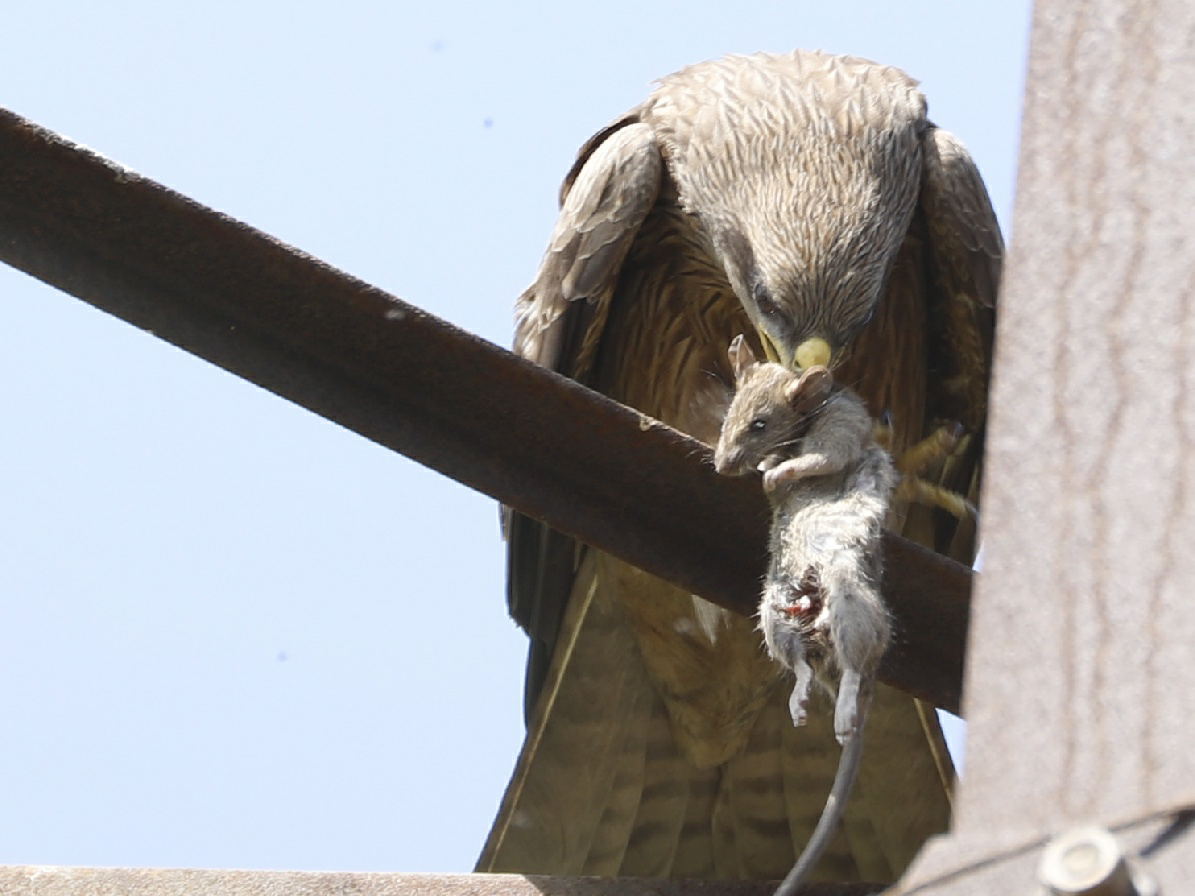
Just when we decided to head back "home", I noticed two kites, I wondered if these were the same ones fighting with each other just a while back, on a high tension electric pole, one of them was sitting with something in her mouth. Soon the lens moved up in the direction and I noticed one of the kites was having fun playing with her hunt, a rat. Another kite instead of fighting was looking at the first one with appreciation. It was quite a sight. Satisfied with few clicks, we moved on after bidding goodbye to our nephews.


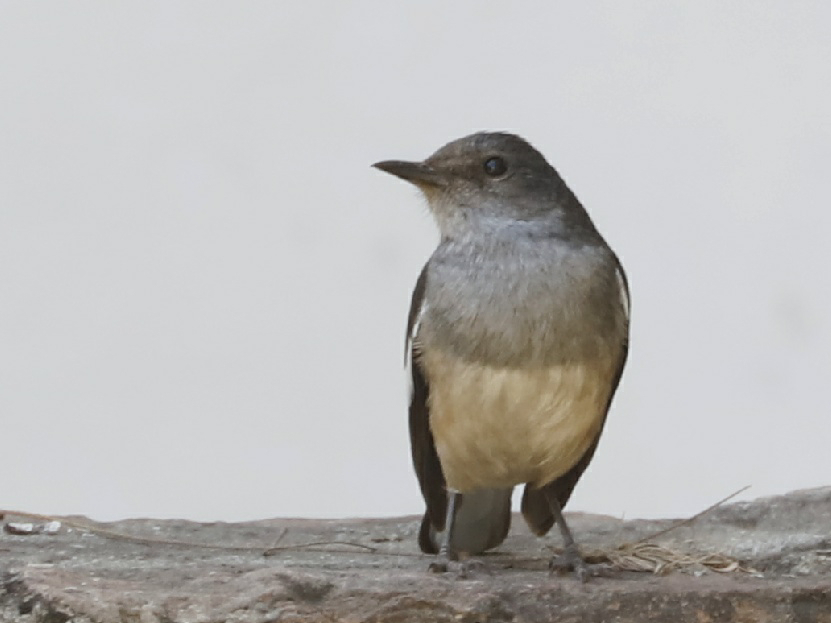
Next morning I woke up to the chirps and it was a wonderful feeling to begin the day. Going out into the verandah I didn't forget to carry my camera. I couldn't return for my tea until I had captured these beauties. A female Oriental magpie robin, a Lesser Whitethroat and a Tailorbird. There were some sunbirds playing and singing hopping from one tree to another but they were madly drunk and didn't give me a chance to "shoot".


We had not visited this place in the last 18 months, it was the pandemic that stopped us for over a year and we were not sure when we headed there on a Friday. We had planned to stay overnight but it felt so quiet, pious, fresh and my feathered friends also showed up to entertain me so that we ended up spending entire weekend there. I promised these friends and Bholenath Baba to return soon and we headed back to the chaos of the mega city.

PS: All pictures clicked by me. Station pics 13. NOV.2016. Rest of the pictures Feb26-27, 2021. Equipment: Canon 600D, Canon 6D mk 2 and One+3T phone camera.

Sunday, February 28, 2021

My First Bank.

In 1964 in mid summer when we shifted to Betma it was in development phase like rest of 600,000 other villages in the country. Its proximity to Indore, the largest city of Madhya Pradesh, kept it as modern as possible. There was no electricity, no telephone, no banks, no piped water and many other things that are indicative of progress and prosperity. Fortunately there was a Secondary school that had started as primary in 1915 and quickly moved on to become a high school even before independence. There was a post office also in Betma since a long time, I couldn't figure out when was that established but I think it was there since pre independence era. In those days post offices didn't have a separate staff and were managed by the school teachers alternating as Postmasters. In Betma it was the duty of Mr Anand Rao Joshi who was a primary school teacher, primarily. He was no relation of ours but being the same sub-section Brahmin belonging from Dewas he was know to my parents and we used to call me Mama. He was very humble and honest and did his duties diligently. He had three children all younger to us Prabha, Pratibha and one more. We didn't have much in common but sometimes when we visited them or they visited us, we met. Besides Mr Joshi there was a postman who was the only full time employee in the post office. He helped in taking the dak in a huge khaki tarpauline material waterproof bag to bus stand to load it in some designated bus/buses that went to Indore and Depalpur which being district and tehsil places respectively had bigger post offices that will collect mail from and send mail to Betma. He also delivered mail and money orders to people in the village. There was no telegraph office in Betma either with postoffice or standalone and postmaster went only in the afternoon for a couple of hours even then there was hardly any activity there. 

Our shifting to Betma was lucky for it, as within the same year the work for electricity connectivity began and in a year or so houses started getting electrified, our turn must have come in two years or even later. Around the same time when I was in the primary school studying in the, 5th in late 1965 or early 1966 we got our bank too. Telephone, however, took longer and an exchange that was placed in a premises that department of Post and Telegraph popularly called P&T rented in the house owned by Chandrakunwar's family who lived on one side of the exchange the other being occupied by a Jajoo family whose son Mahesh Jajoo was two year my senior in the school. They had a  big clothing shop in Poora Bazaar managed by his father and uncle Badri Seth. But Betma got telephone exchange between 1969 and 1970 and when that happened it was a bigger excitement than any other invention that patronised Betma. The first telephone connection was given to the Police Station and the honour of first private connection went to Harakchand Seth, unfortunately Jeevanram Seth his father, couldn't get the benefit of this in his life time. I am not sure if the technology used for the exchange was Strowger or Cross Bar but once when I managed to sneak in with someone, I was aghast with the huge machines making lot of noises so much that people couldn't talk there. With just 20 odd connections the relays were constantly making connections and getting disconnecting contributing to the noise level.

There may have been some 10 or 12 racks of large almirah size having lots of wires and up-down switches going here and there. Initially people couldn't make calls from home to anyone and phones just had a receiver (a mic and a speaker combined) but no dialer, as soon as you picked up the receiver it will ring in the exchange and an operator will come on line and ask you who you wish to speak to and connect. I think intially you could call only within Betma and it was more a thrill than a benefit as in the time that you got the connection you could run and talk to the intended person. In later years exchange started connecting out locations also and phones were replaced with a phone with dial. However, subscriber trunk dialing (STD) was introduced in the early eighties only. Speaking to people in Indore wouldn't take more than 5 minutes of connection time but calling someone in Bombay or other places you would have to book a trunk call that sometime will take couple of days to materialise. I will talk more about communication era later as there is a a lot and interesting stories out there. I wondered if people on either side of the exchange premises could sleep or rest properly after it was installed.

Mohan Lal Neema was a respected and pleasant person who studied in school with my father so they must be of same age. After schools my father passed Inter and became a teacher and Neemaji completed his graduation and became a politician. He was member of INC but didn't held any public office not was he ever got elected. But he always appeared busy so must be an important person in the party or because of his connections. I, however, don't know what he did for living. His house was in one end of Poora bazaar soon after which the hugely wide market became narrower. He also had three daughters, two older than me and one younger. Eldest one must be 5 year older than me and the middle one about 2 and the youngest one must have been 2 year younger. Middle daughter who was pretty good looking and petit girl studied with Damu and was a year ahead of me. She was the only one of the three with whom I had some conversations in the school. But in 1965-66, I had no interest or information about them as we were busy playing with our direct friends. Sometime in late 1965 and early 1966, I could see lot of activities in their house at the end of which I saw the shape of the house completely changed. Half the portion where they lived remained same but the other half was modernised with high sealing roof and an open large hall with some partitions. Some days later I saw a big board coming up there with "Bank of India"  written that also had their famous BOI Star logo. 
Not only  people who lived in Betma but people from neighborhood villages were also coming to Poora Bazaar curious and excited about this newest pride of Betma. Many people including me had no idea as to what a bank was and some others explained to them this is a government institution that will give you money at much lesser cost than what Seth Jeevanram offered and you can also keep your money with bank that will be safe ( with the government) . Some sahukars (moneylenders) also felt threatened. Mr Neema had made a permanent arrangement for a regular income by renting this part of the house.

The day of inagration was like a mela, the ribbon was cut by some VIP I think the district collector and everyone was feeling important being there on the first day. Biscuits, samosas and tea was kept out for everyone who walked past. And as a part of the inaugural function an essay competition was organised by Mr Punglia, BOI's branch manager. A tall fair and handsome Mr Punglia was all smiles with the trouble free inaugural function thus far. I was one of the school children who participated in the essay competition and went dressed in my best. I don't recall the topic of the essay but after we submitted our write-ups and judges went through them I was declared winner. Amongst applause I was given the certificate, a writing notebook, a nice plastic footscale with BOI logo engraved on it but the best was yet come and when the guest of honour gave me Rs 25 cash award I was on cloud 9 as I don't recollect if I had seen or touched so much money before. Till date I consider that as my first income that made me feel independent and worthy.

Mr Punglia then explained me about banking in some simple words and requested me to open a savings account in the bank. That I did and hence there started banking journey of my life as an eight year+. People who visited bank several years after its opening found my picture that decorated the walls amongst others as the first day bank customers.

 My love for BOI remained throuhout since and I still hold an account with them. 

Saturday, February 27, 2021

Culturetenment in Betma - part 2

I wanted to give memories that took me back to Baby Indira's record action dances, some rest after putting them down to Google cloud, where once you deposit anything remains till iternity. But when I set out for a long drive over the weekend and switched on radio, it was playing 1966 songs on Vividbharti and that 45 minute long programme set me back to the stage where I left Baby Indira. The songs that I distinctly remember she used to dance on were being played on the radio sequentially a) titli udi, ud jo chali, phool me kaha.., b) suno sajana papihe ne..., c)  khat likh de sawaria ke naam babu..and d) phool ban jaunga shart ye he magar...besides hits of that year. That put a screen over  my windshield and I was watching Baby Indira again while on the wheels driving at a highway speed focusing eyes on the road and ears on the songs. What a coincidence!

But 1966 was not the only time she came to Betma and subsequent trips following years did nothing to take that charm away. I used to be as dumbfounded as when I saw her for the first time, as if under some spell. I remember this happening thrice while I was in Betma. Another incidence added to my attraction for her was entry of another set of dancers. Seeing the success of the troupe that Baby Indira was a part of, a competition also surfaced and another theatresade an entry thar had not one but two stars.. sisters Baby Suman and Baby Mangla. Their theatrics/plays were not so well received but since there were two dancers the whole 2 to 2 1/2 hour show consisted mostly dances what we called record actions and some skits instead of full plays. That also made them more competitive by employing lesser number of artists and other staff. But that apart, Baby Mangla was too young and may have been just about two or three year older than me and Baby Suman another 1 or 2 years. They both danced well but it was not the same. Their shows were houseful because they were entertaining and could dance on a much wider range of songs as on some songs they both danced together. Their troupe was stationed in the Police station premises and nearer to the bus stand that added number of "walking customers" some of them waiting for their buses, that they often missed. Well, the fun continued till I left Betma ..  now it was कभी ये और कभी वो kind of option.. that added two more feathers to my cap. Now I wonder with such preoccupation, how I topped the class year after year.

------

When I entered 9th that was the first year of secondary school, we had to choose between science or arts unlike these days when you face that question after passing 10th. Although I fancied literature there was nothing that stopped me to choose  PCM that stands for Phisics, Chemistry and Maths with Hindi and Sankrit. I would have gone for biology instead of mathematics but that option didn't exist. It was too early for me to have a choice between engineering , medical or arts (humanities) but the general "impression" was that the first two streams were meant for people who were "better in studies". I had seen more doctors but not known any engineer besides one of my father's cousins so becoming a doctor was more fascinating but that dream got culled before it became a dream due to "option not available" sign. So that was the beginning of my engineering career before entering the engineering college. Once you have opted PCM in class 9th you are bound to dream to become an engineer as no one found the word scientist fascinating and people who were aware to the the educational system then, knew that after doing BSc or MSc what you become is a lab assistant or a science teacher in a school. There was no institution then that was known to produce Scientists. At least with the then limited knowledge me and my classmates had, said so. In my class I had Premchand Patidar a studious and hard working fellow who cycled from Methwada a small village some 14 Kms away. He was not the only one though who peddled so much even Naveen Shukla, another one of my new classmates paddled same distance everyday when he traveled from Ghatabillod to Betma. After spending a year in class 9th our friendship was all but obvious. Although I didn't consider Patidar a competition but he did. He had an edge over me in the eyes of Dr DP Mourya our maths teacher who had just submitted his dissertation for PhD and was hinting to join Holkar Science college in Indore once he is awarded the degree, that he later did but not before us passing 10th. At least that's what Patidar thought.
Sometime in the summer of 1970 when we had passed class 9th and were promoted to the 10th, Premchand's brother's marriage was fixed and all the PCM students were invited to attend that. Those were the days when marriages in friend's families or anyone known in the village didn't require any formal invitation as such. These festivities were open to everyone in the village especially when you have known the family one way or the other. I didn't have any transport to reach Methwada so I remember walking some distance on the main highway with another classmate before we requested a bullock cart to offer us a ride once the pabble or the mud road started.  On our way was a very small village called Ravad (रावद). After walking for about an hour in hot sun of May, I was thirsty, so went to a house and asked the lady who was busy putting a layer of cowdung over the elevated entrance of the house as was common to keep the house clean and disinfected, for a glass of water. She looked at me and asked कौन जात? ( Which cast). Innocently I said बामण (Brahmin) and before giving me a glass of water she almost touched my feet 🤔.

The bullock cart joy ride would have taken another 30-35 minutes to take us to Methwada. It was late afternoon. Festivities for marriages used to be a long affair then and we had reached just a day before the D-day. We had no plans to join the barat the following day that was to proceed to another village where bride's family lived. We got good reception from the family and something or other kept going at the couple of houses in the village where celebrations had started. I was not interested in those so just took a stroll in the village till the sun went down. Soon I saw a crowd gathering at one of the venues and made my way to that. Everyone was excited and I got to know that soon a nautch was going to begin. It was not a traditional nautch that I had seen in some movies or the record actions of Baby Indira, Baby Suman or Baby Mangla but more like the one that I had seen in haat bazaars performed by "women". Much later I got to know that they were third gender people and were called hijras ( or eunuchs). But the style was different and watching  closely I noticed that some womens were women and some others were women like the haat bazaar kind.. marriage guests called all of them nautch girls. They must have been of varying age from late teens to late forties and were dancing to the rhythm of a dholak and singing folk wedding songs, lyrics of some of which I found embarrassing. However, I noticed most villagers and relatives were ecstatic.. singing and dancing with those girls and "semi-girls". As it started getting dark the tempo of rhythm kept increasing. After a while I was hungry and dinner was served so I moved there with some friends. Even after dinner the dance "festival" was continuing and I noticed the guests who were dancing were totally drunk and kept falling instead of dancing. People were also showering  rupee notes on the girls and throwing in the air that the dholi was collecting. Slowly people started moving and so were girls but movement of some people looked suspicious as they were talking in whispers and holding hands of some women as they went away and vanished. Dances were still going but my friends and I decided to call it a day and when we went to one hall where some guests were sleeping. 

Much later I was educated on the happenings around. That was and perhaps still is a culture and is a way marriages are celebrated in villages. Next morning Patidar family gave us a send-off and my friends and I returned in the bullock cart that was arranged by Premchand for us to take back to Betma.

It was another first experience attending a wedding without my family and I felt more grown with this other kind of entertainment.
----

Representative picture of nautch downloaded from Internet.